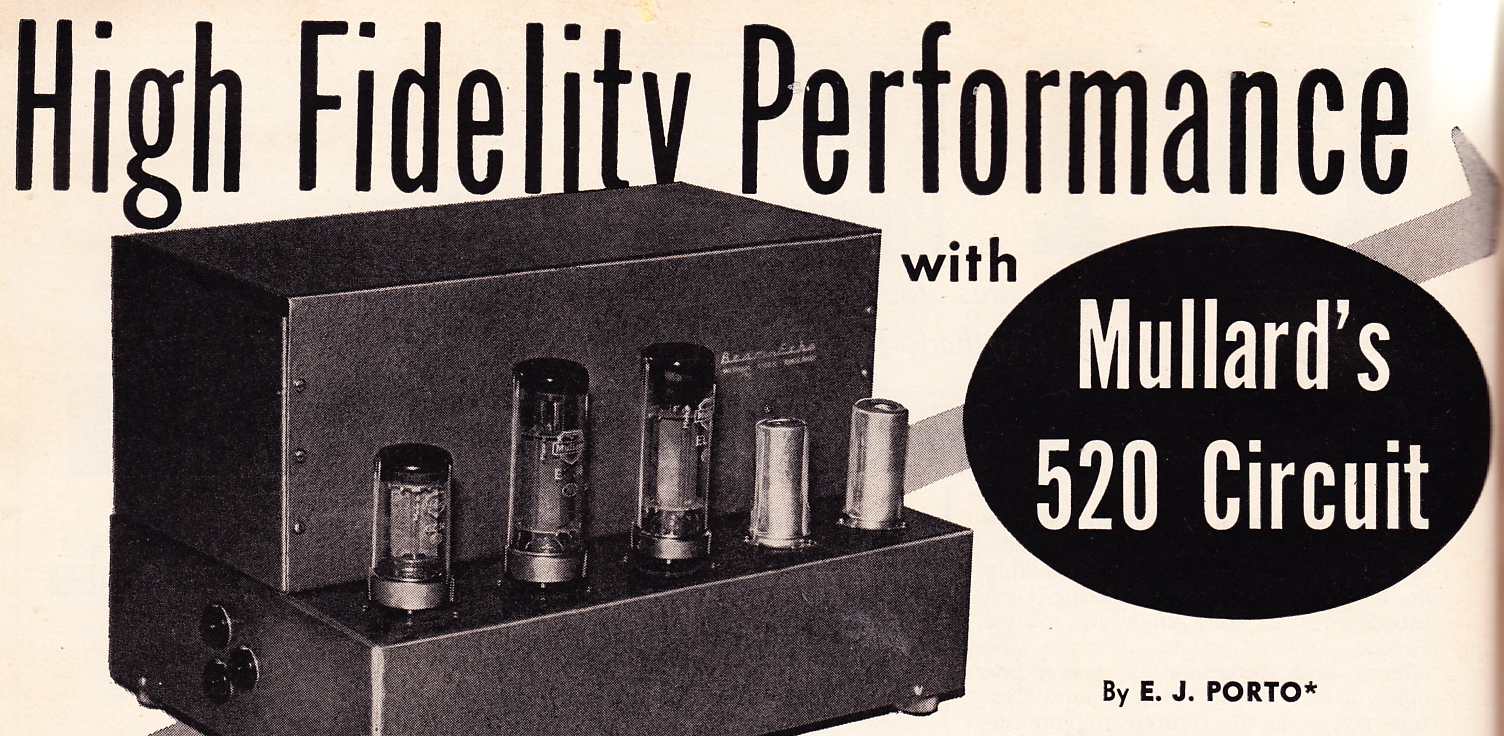
 Download a four-page article from “Radio & Television News” 4/1956 regarding the Mullard 520 power amp:
DOWNLOAD: Mullard_520_amp
American industrial titan RCA offered schematics for a variety of tube-audio equipment in the back pages of their many “receiving tube manuals.” Mullard, a prominent British maker of vacuum tubes, similarly published a book entitled “Mullard Tube Circuits For Audio Amplifiers” (h.f. “MTCAA”). The designs are quite different from RCA’s, as Mullard promoted different tubes: EL34 rather than 6L6/5881; EL84 rather than 6V6; GZ34 rather than 5U4; and EF86 rather than 5879. The MTCAA also offered extensive plans for the fashioning of the actual sheet metal cabinet and transformer-cover. The four-page article I am offering here is quite different from the one in MTCAA, but either will get you on yr way to building this unit.
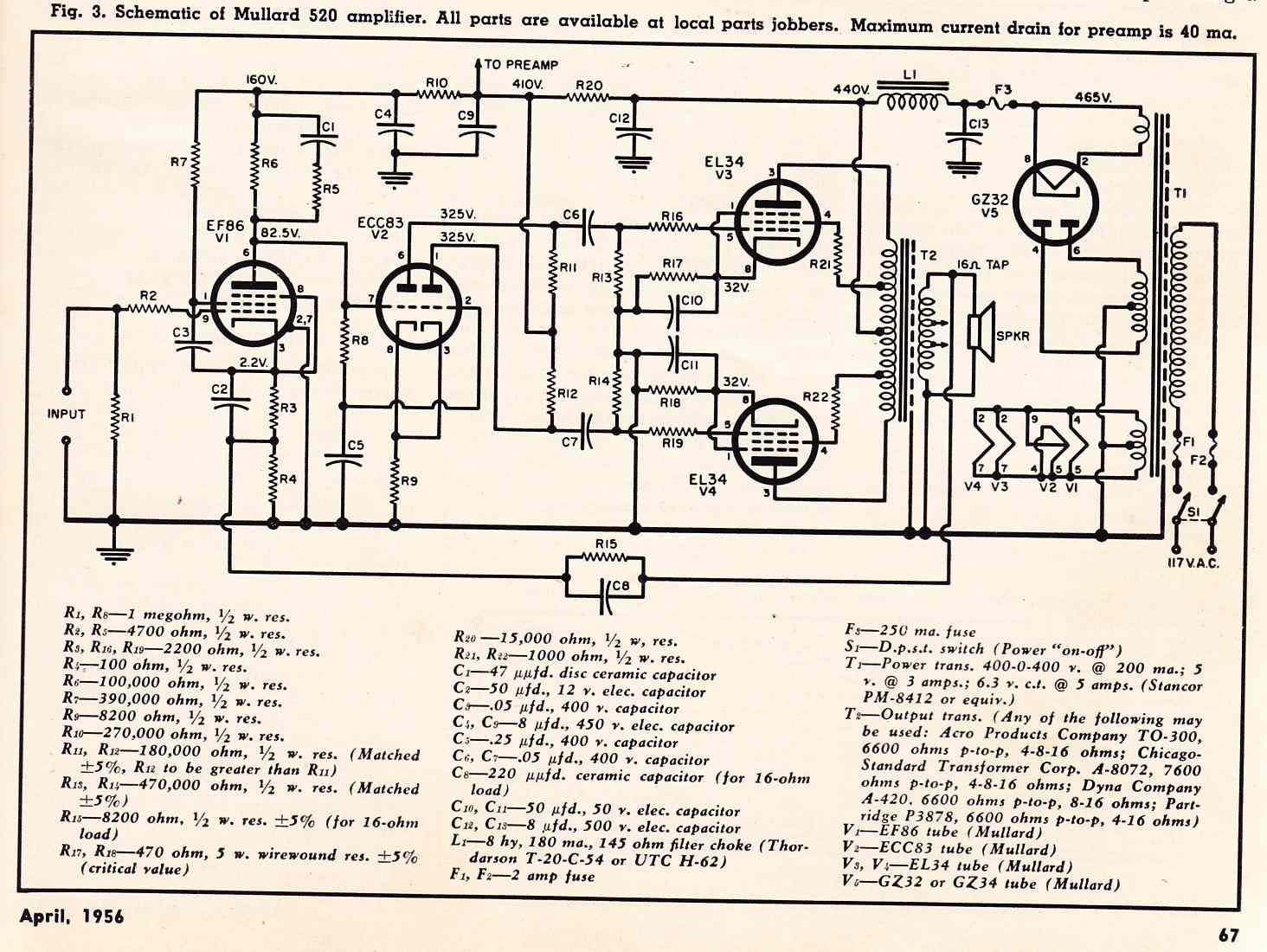 This design promises 35 watts from a pair of cathode-biased EL34s. It does require an ultralinear (IE, with screen taps) output transformer with a 16ohm winding for the negative feedback loop (such as this EDCOR model), but other than that it’s all very basic parts. Now if I could find some good cheap EF86s… Anyone try the new $17 Electro-harmonix EF86?
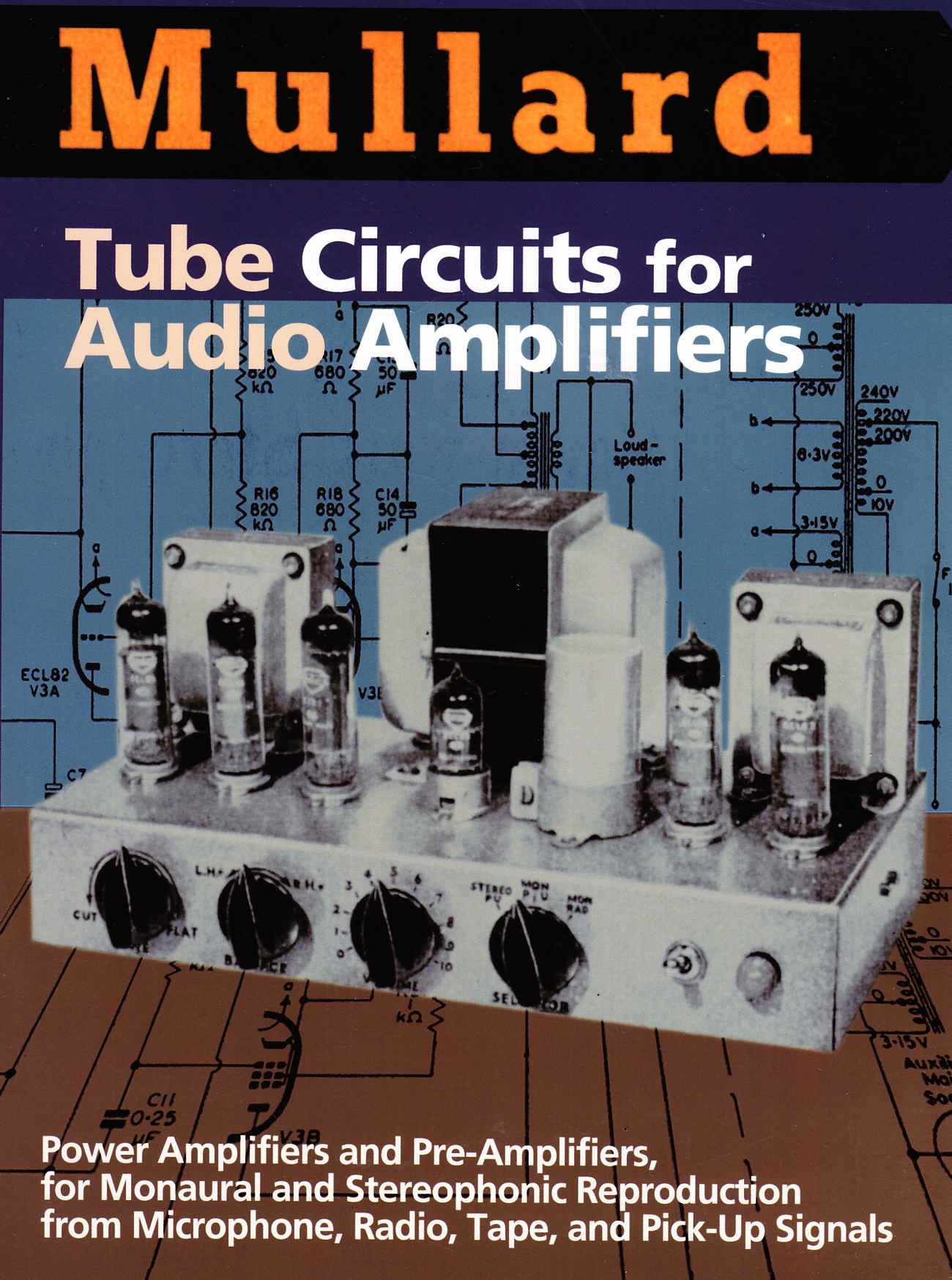 BTW, The Mullard book is still readily available as a reprint; well worth the $17 cover price IMO. There is a circuit for a 3-stage ‘mixing preamp’ featuring EF86 pentode inputs with a 12Ax7 on the back end, the second triode of the 12ax7 wired as low-impedance cathode follower… pretty tempted to try that one… anyhow, you can buy ‘MTCAA’ at Amazon Dot Com or at Antique Electronics.
13 replies on “Mullard 520 Power Amplifier c.1956”
O meu amplificador, montado por mim, usa um circuito Mullard modificado, pois não usa o pentodo EF86 na entrada e sim, meia 12AX7 mais duas 12AU7, ligadas em paralelo, como se fossem uma! Isso confere ao amplificador uma qualidade superlativa, por outro lado, oferecendo uma baixa impedância nas grades das EL34, anulando assim, o efeito Miller, próprio dos estágios de carga distribuida. (não uso a terminologia, “ultra-linear” dos senhores, David Hafler e Herbert Keroes, pois isso, apenas um artifício, para poderem se apossar de uma inveção que não foi deles, o tráfo de saída com primário em carga distribuida, e poderem tirar patente, de uma invenção que não foi absolutamente, deles!) Em minha opinião, os dois circuitos Hi-Fi imbatíveis, foram o Mullard 5-20 e o genial amplificador Powrtron!
Sir.
I guess you mean that you drive the output tubes via ECC82……I certainly agrees that this is a better approach. I am not sure I would want to use a paralleled ECC83 as first stage. A single triode should do the job, and it is still possible to maintain the DC path to the phase/driver.
It is a nice amp, either way……
🙂
Kurt
Com referência ao amplificador citado por mim, que usa um circuito Mullard 520 modificado, fiz um apdate, retirei as EL34, e substitui pelas 6550, troquei os transformadores de saída por outros de 60 watts, com uma carga de primário de 4K3! Com +B de 450volts. Acho que quase consegui alcançar o “santo gráu sônico” Obs: as vávulas de saídas, trabalham com fixed bias!
The ECC83 in the design above is NOT ‘paralleled’, the first (left) triode grid is fed with the audio signal (and bias) from the EF86 and outputs at its anode the drive for the first (upper) EL34 output valve.
The second (right) triode of the ECC83 receives only the bias D.C. voltage from the EF86 anode – as it is decoupled at audio by the capacitor to ground; this triode acts as a phase splitter as it’s in common-cathode connection so outputs at its anode the drive in opposite phase to the second (bottom) EL34 output valve. That way the pair of output valves (EL34’s) operate in push-pull into the output transformer, properly balanced.
The designs are not different because the tube types are different but because of differing ideas on each side of the pond. There was a great interplay between American writers in “Audio Engineering” and British ones in “Wireless World”, because those magazines were readily available and obviously readable in each other’s country. The Germans and Italians and whoever else had ready access to neither, although the German magazines and publications of the period were at least as good from what I have seen. I can read technical German better than I can technical flavors-of-Latin (of which the poster below has picked, apparently, the most obscure, save perhaps Romansch or Romanian) and have found there is a LOT of good stuff in German, and a few things in Swedish, Italian, and of course the Asian languages of which I have made no attempt to interpret beyond the English legends, schematics and photos. (My father studied Classics under one of the most notorious professors in America at that time, at the University of Illinois Urbana, an old guy who scared the hell out of me as a kid. I once asked him if I could learn Japanese and his reply was, “Only if you want to learn nothing else all your life”. I think even Alan Douglas, whose seminal article “Tubes in Japan” was the inspiration for guys like Joe Roberts and “Doctor Low-Mu” the vacuum cleaner salesman, finally gave up on it.)
But you could get Partridge, Parmeko and other Brit transformers, Mullard and GEC tubes, British books like the above, and of course Quad and Leak electronics and Wharfedale and Tannoy speakers in the US fairly easily. German stuff was unobtanium even if you knew what you wanted. No one stocked it and ordering it meant knowing German and hoping Steven Temmer hadn’t got a lock on it.
I always thought it was sad McIntosh never built a 100 watt amp using a pair of EL156s…
At any rate, the Mullard and GEC books (the GEC is available free online) are well worth reading. A look at Marantz’s 8/8B shows obvious Mullard influence, but Marantz wisely used fixed bias (cathode bias makes no sense in hi-fi today) and a more sophisticated feedback scheme.
Those old Radio and Television News are more fun to read for the ads and the general flavor shown in articles, but there is still a great deal of interesting tech stuff and I’d love to be able to buy them as an e-book today. It would be vitally important to scan them so that the margins are not blurred, though.
In this circuit, the output transformer is going to be pretty critical and it’s interesting that it lists several commercial ones some of which I know to be quite different from each other. I really wonder if they built this amp and tried each of the recommended ones for stability with the component values listed.
Would I build one today? Hard to say. I think an all triode front end would be better, especially as the EF86 was a noisy tube as I recall. Are there some more common pentodes that would give the gain needed with less noise? I’ll look through my RCA Receiving Tube manuals for some ideas.
you can download a copy for free of the Mullard Circuits for Audio Amplifiers from here:
basaudio.net/blog/wp-content/uploads/2013/01/19400164-Mullard-Circuits-for-Audio-Amplifiers.pdf or 19400164-Mullard-Circuits-for-Audio-Amplifiers – BasAudio.Net
Steve:
It’s probably just me, but…..when I had “Copied & Pasted” the URL link you have provided to download the “MULLARD Circuits for Audio Amplifiers.pdf”, I received the following error message:
404
The page you requested was not found.
Do you have anything more recent and/or updated? THANKS!!
JBWilliams
/
I’m a bit late to the party but try this link if you don’t already have the PDF:
https://www.worldradiohistory.com/BOOKSHELF-ARH/Circuits-For-Audio-Amplifiers-Mullard-1963%20.pdf
ola econstruido infinidad amp valvulares tengo experiencia en puss phull ultra lineal ytriodos varios desde 2a3 a6550 tambien en sigle ended mi experiencia me dice que el mejor circuito es el mullard pero tiene muchas variantes no todas suenan bien lo mejor esde entrada una 5751 sonido sedoso lo mejor como divisor defase 6sn7 desalida desde 2a3 6b4 el34 6l6 6550 en cneccion triodo ojo respetar tenciones y cargas el punto clave es el inversor alimentarlo con 430 v tension de rejilla 11o 115 v seria muy largo explicar mas detalles cualquier duda cnsultar
R9 should be 82,000 ohms, not 8,200 ohms.
I am looking for the Armstrong A 10 MKII Amplifier ‘s schematic, Can anyone offer?
Thank you!
Please contact me liuxiangui@126.com.
HI what can I say we brits Do what we Do best this is where we excell in valve amp Design others make great amps as well but it.s mullard who started it went from there there are also great transistor amps eg leak armstrong quad etc very sought after still around the world need I say more .Happy building David Douglas