
Many years ago I wrote a brief post about the Audio-Technica RMX64 4-track cassette recorder (hf. ‘RMX’). In all those years since becoming aware of this remarkable, enormous, 50lb machine, I never actually set my eyes upon one until a recent local auction.
The machine worked OK when I brought it home. Play and record worked fine; every switch and i/o jack worked fine except for one single buss-assign switch; the only major flaw was that FF and RW did not seem to work, or at least not consistently.
I brought the machine to the gentleman who services my studio reel-to-reel machines, and in a few weeks time I had it back. It needed an idler replaced in the transport, and he advised a pricey ‘complete disassembly’ in order to inspect every solder joint in the thing (the one bussing failure that i had noted was due to a cold solder joint, so he felt there would be more; and there were).
Anyhow, the whole operation wasn’t cheap, but at long last i had a perfect, and I mean, flawless RMX to put thru its paces. I had about a day-and-a-half to play with it before it moved along to its forever home. Here’s what i created on this thing in that day-and-a-half.
I’ll present the production processes for both songs, one at a time.
Song 1:
The first tune I cut is a country-rock number that i wrote a few years back after re-watching one of my favorite films of the New German Cinema. I’ll let you guess the title. Click the little media-player interface below to hear the finished song.
Here is the process that i used. First i recorded a quarter-note click track down on track 4. Then i recorded the main 12-string AC RH gtr track on one. It’s a lot easier to get the right drumkit performance if I can actually hear a musical guide track rather than just playing to click and singing along in my head. Playing drums in a vacuum is no fun and it also causes me to fixate too much on details that won’t matter in the final mix.
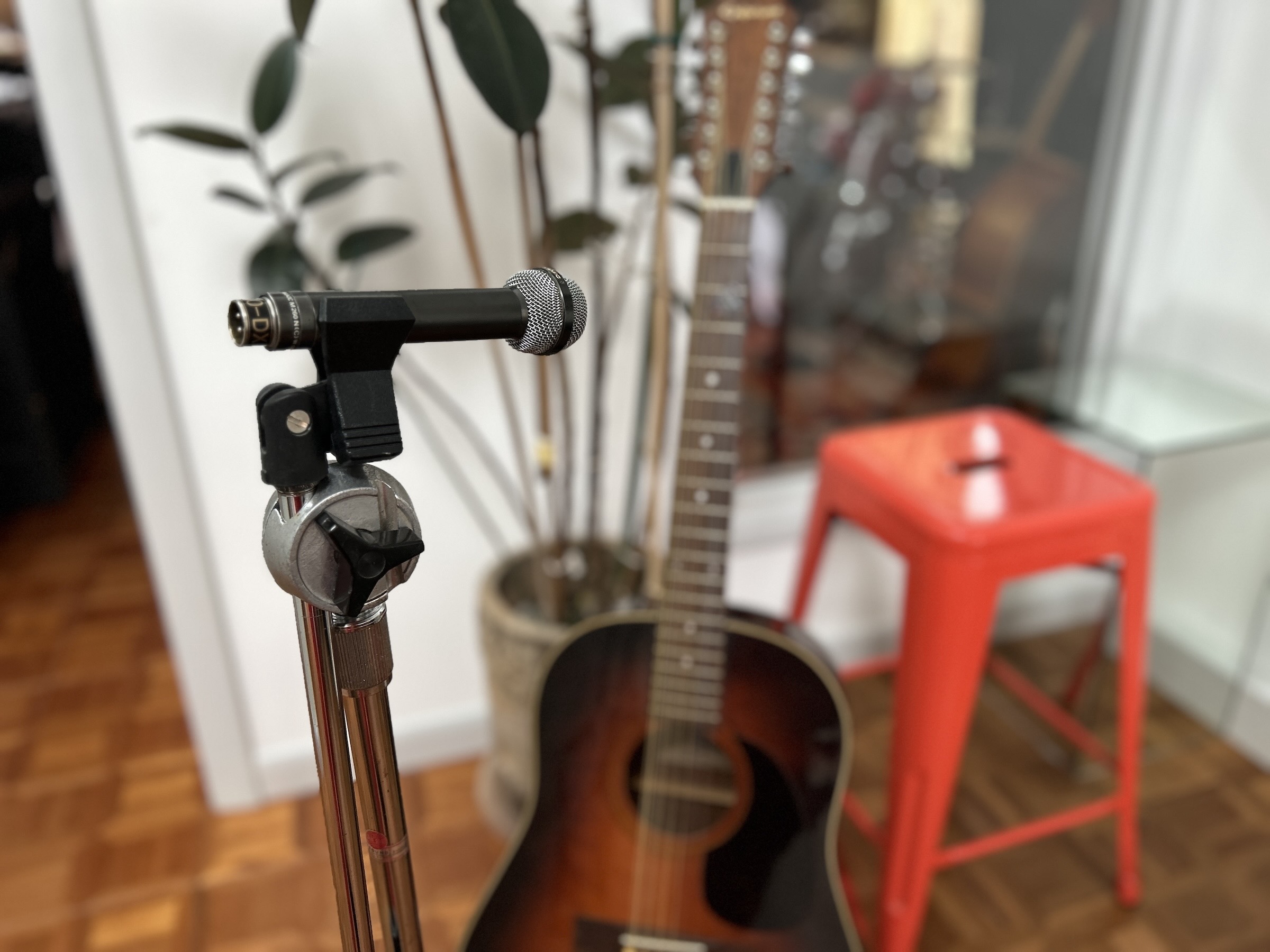
For the ac gtr part I used a Beyerdynamic m260 cardioid ribbon mic that Stephen Sank modded for me some years back (his ‘DX77’ mod- he has done five M260s for me, highly recommend ). The guitar is that great-looking 70s MIJ Epiphone you see there.
I always put some muted count-in strokes on the gtr part, since I will have wiped the click track before we finish the tracking. So it’s necessary to have a new count-in added to at least one of the keeper audio tracks.
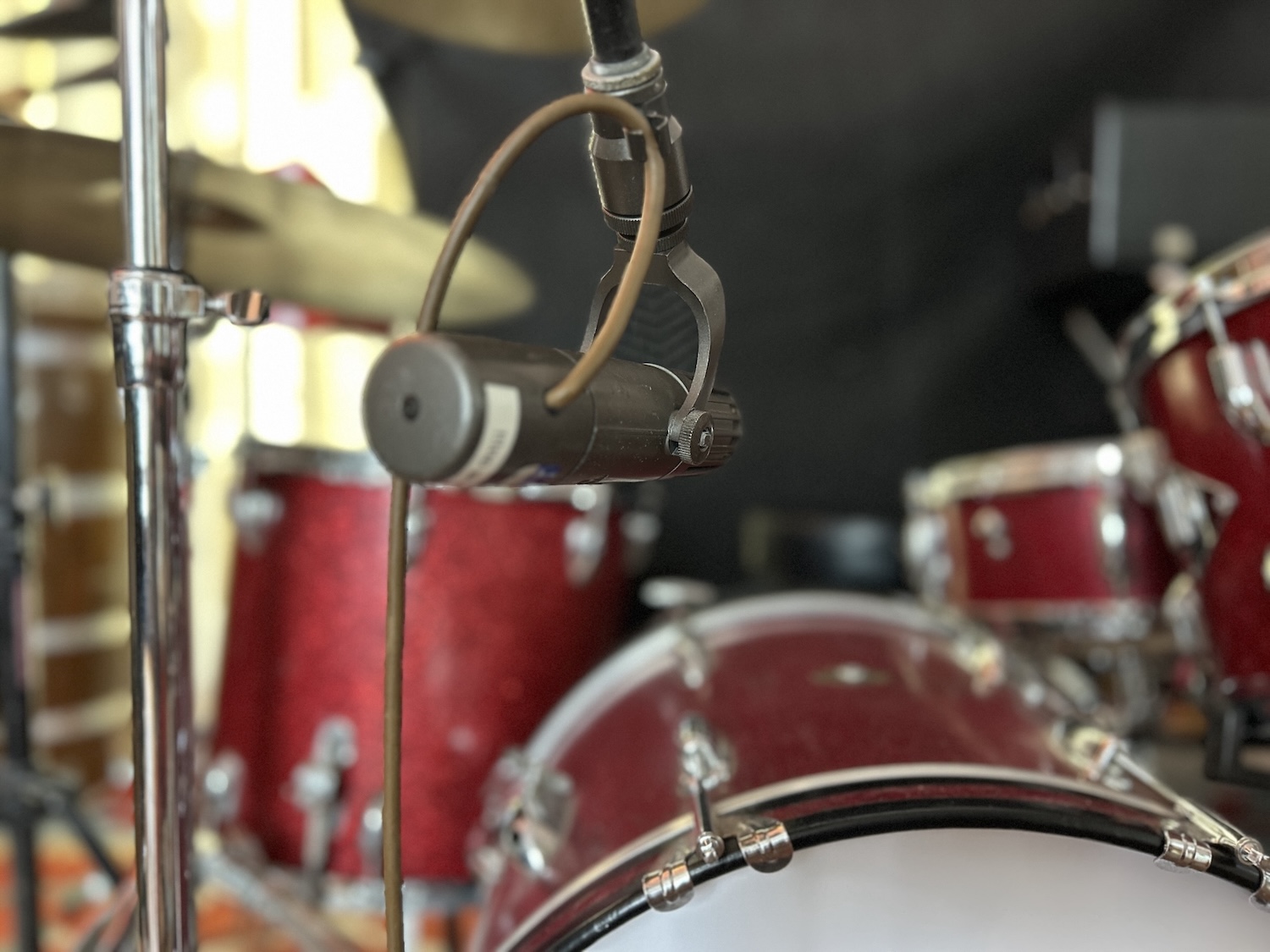
Next was one-mic drums on track 2. I used an RCA BK5 positioned roughly above the kick, aimed at the snare. I put it close to the rack tom in order to make that drum sound big (too close, as you can hear in the recording! but it kinda works). Now, i woulda liked to try doing a multi-mic setup here, but one feature that the RMX lacks is phase-invert switches on the inputs. So it woulda been tedious to get a buncha mics in-phase by myself while playing the drums etc. Single-mic drums have their own charm anyway, esp. as you will hear on the 2nd song, after i made some adjustments. Anyhow back to ‘The American Friend’:
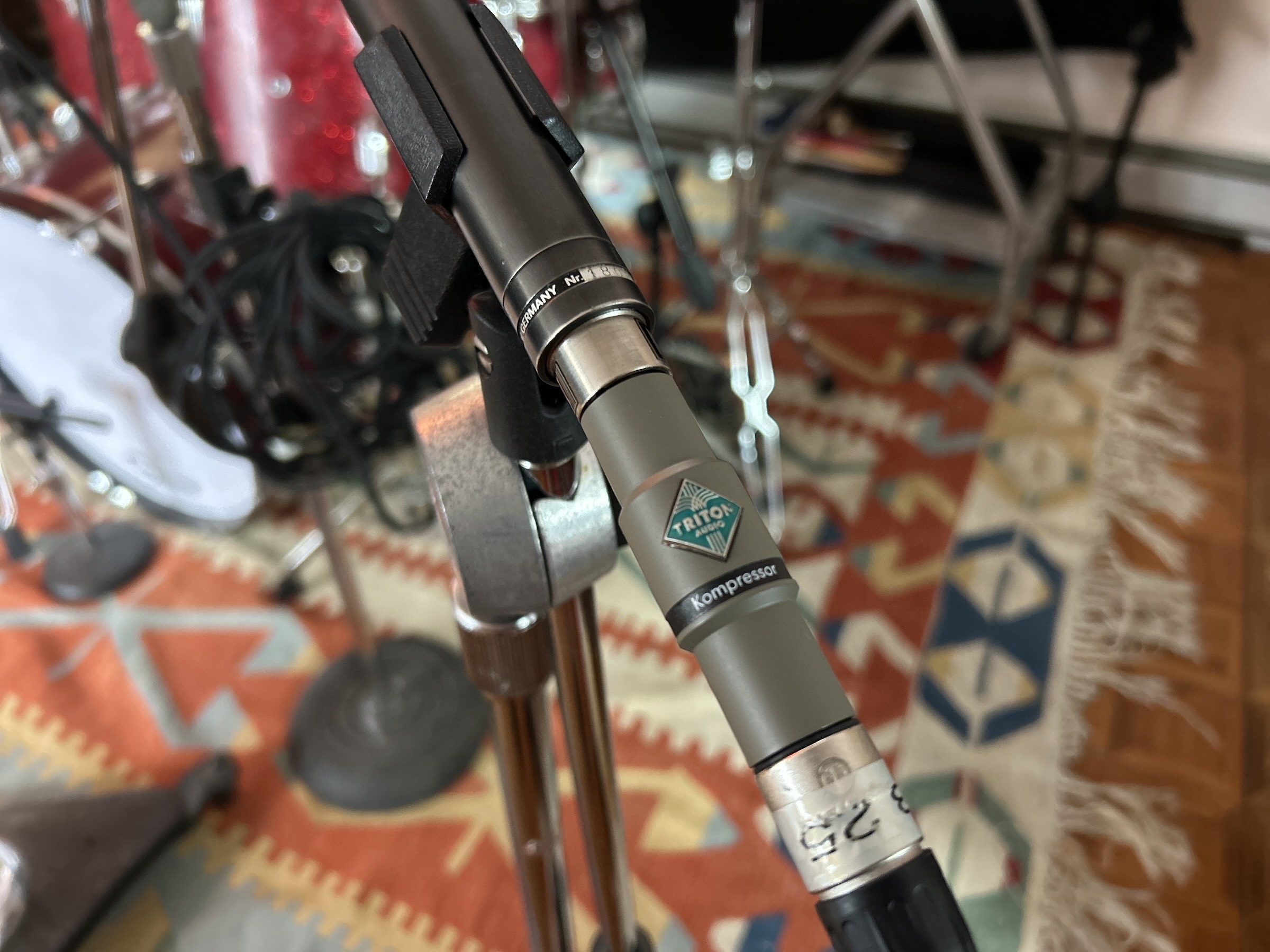
It’s important to note that on this drum track, and on many of the tracks in these two recordings, I used this handy little $99 Triton Audio Kompressor. This is a tiny 48v-powered inline mic-level opto compressor. It has a single knob for setting the amount of compression, and one LED light for visual feedback of the compression process. it sounds great and it is super-handy for getting a strong and consistent level to tape, which becomes especially important as we bounce tracks within the machine and the potential for excessive tape noise increases. Now, it does require 48V phantom power- and not many cassette 4-tracks have this feature- but if yours does? Highly recommended.
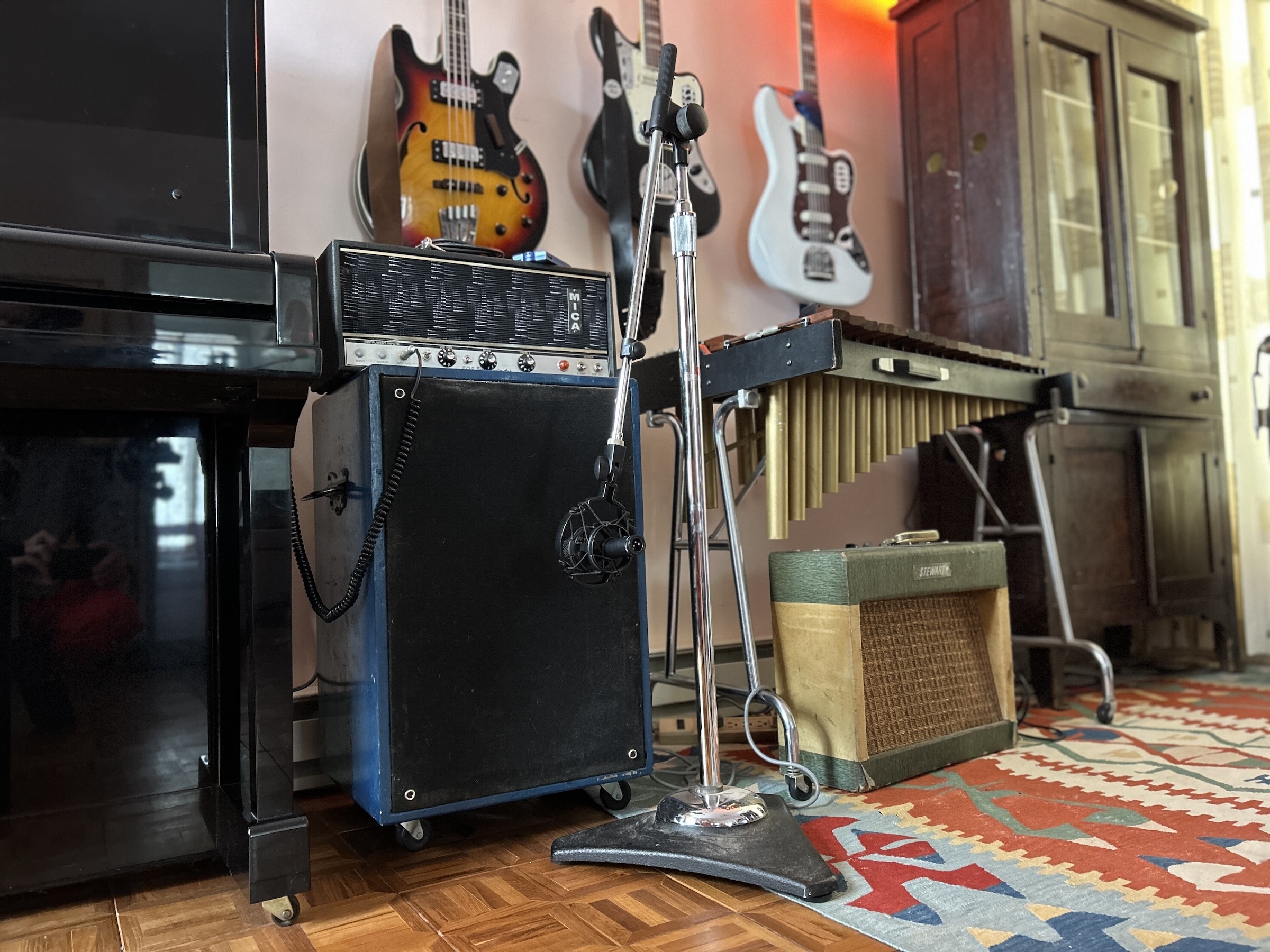
Next was bass guitar on track three. I used my Squier Bass VI, with a pick + palm-muted, into that lil piggyback amp rig you see there. The head is a clone of a blackpanel Bassman that i made last year (bass channel only!) and the cab is a 60s JBL… a D130 i think? It’s mic’d with a Beyer M88, also using the Triton compressor.
OK so now we have Ac Rh gtr on Tr1, Drums on TR2, and Bass on Tr3. It’s time to wipe the click and do a bounce.
I found the extensive EQ of the RMX especially useful for the bounce. Most helpful was the variable hi-pass filter function. You can get very precise with removing unnecessary low-end noise and rumbler. The high eq (the machine has two types available per channel, via a pull-pot) is incredibly smooth and just great-sounding. I was using Dolby C on this recording, and TBH even given that i really did not need to add much high end to the drums or the ac gtr. It’s a really good-sounding tape deck.
So I made a mix of those three instruments and bussed them to track 4, where I would wipe over the click track. I also picked up some different tambourines and after determining which one fit the feeling of the recording best, I put it in front of the Beyer 260 again, swept up the hi-pass filter to cut all the crap out, (no compression on the tambourine!) and bussed that to track 4 as well.
So on track 4, we will end up with: 2nd generation Ac Gtr, Bass, Drums and first-gen tambourine.
Why do i do this? A few reasons. *I’m not a drummer, so having another, more controlled 16th note moving with the hi-hats really helps smooth out the perception of the drumming. *The tambo is generally the thing that sits highest in the mix (frequency wise), so we want this instrument to have as much hi-end presence AND detail as possible. Having the tambo (or shaker) present as a first-gen part really really helps.
*it’s a very easy part to perform, so i can do other things on the mixing board (fading levels, muting tracks, ETC) WHILE I am playing the tambo into the mix. Try doing that with a guitar part!
This brings me to a philosophical point that I have learned from doing so much cassette 4-tracking recording in tandem with ‘proper’ studio recording for the past decade. You don’t NEED perfect detail and resolution in every single mix element. In fact, you probably don’t want it. If the acoustic rhythm guitar and the hi-hats lose some detail and frequency extension as a result of being dubbed-down in the bounce, but then there is also a ‘clean’ first-generation tambourine part playing along with them that HAS all those frequencies and detail… guess what. You’re probably not gonna miss them in the final mix.
Alright so now we have a balanced and complete RH section (Gtr, bass, drums, percussion) on track 4, and we have three more tracks now freed up to overdub on.
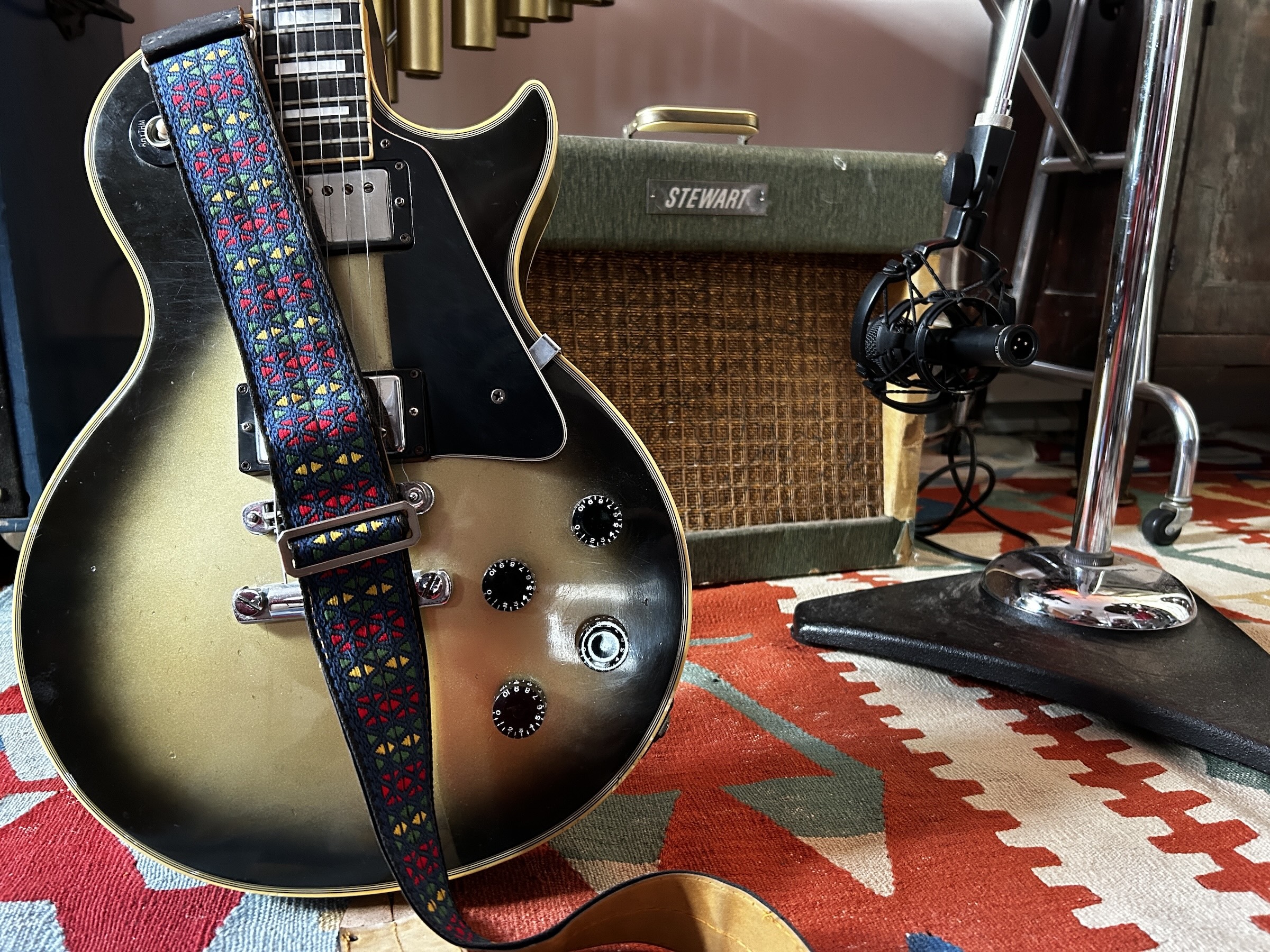
I put the electric lead guitar part down on track 1. After trying a coupla different amp and pedal combinations, i settled on my old Les Paul into a Guyatone tape echo into that little amp there labeled ‘STEWART.’ Stewart is actually a 5F11 Vibrolux clone that I also built last year. It has a number of tweaks that I have developed over the years and just sounds fantastic. Speaker is an old 50s Jensen Alnico. I mic’d it with the Beyer M88 again.
While the song required that i lay down the ac gtr, drums, and bass as entire uninterrupted performances, I could build some gaps into the lead guitar part so that I didn’t need to get one perfect 3-minute take. This is where I noticed something truly remarkable about the RMX versus pretty much every other 4-track I have ever used: there are NO punch-in artifacts. NONE. It punches in and out as flawlessly as a real studio tape machine. And also: the cue time is incredibly fast. Which makes it much quicker to get tricker parts done. I did find it a bit frustrating that there is only a single-point (RTZ) autolocate function (my beloved Tascam 134 has RTZ plus two additional auto-return points), but this is a minor detail, as the digital tape counter is very accurate.
After that guitar part was done, I put down the vocals. I did the understated low octave first, then sang the more expressive high octave to that one, and then re-did the low octave to match the timing and pitch details of the higher voice.
With all tracking done, I played the 4 tape tracks into the protools using the RMX’s 4 RCA tape outputs ( I had to gain them up using some SSL line amps here in the rack). Quick mix in pro tools and we’re done.
One thing to note here about these two mixes, and this applies to all of my 4-track productions: I intentionally bandwidth-limit them to about 50hz to 12,000hz. Not only does this remove noise and allow for greater overall punch and level, it also really ‘ties it all together’ effortlessly as far as getting the 1st gen and 2nd gen tracks to feel of-a-kind. We are talking about cassette tape here, after all, and most of what this medium can accurately transmit beyond these ranges is gonna be noise. Stick to what works. And, again: you won’t miss it. Sonic perception has much to do with how sounds appear in relation to the other sounds around them. By trimming all the highs together, carefully, in the master buss, you get a lot of benefit and very little deficit.
Song 2:
Here’s a cinematic instrumental that i’ve named ‘monument to the revolution.’ I was imagining Scott Storch, but in the Soviet ’80s.
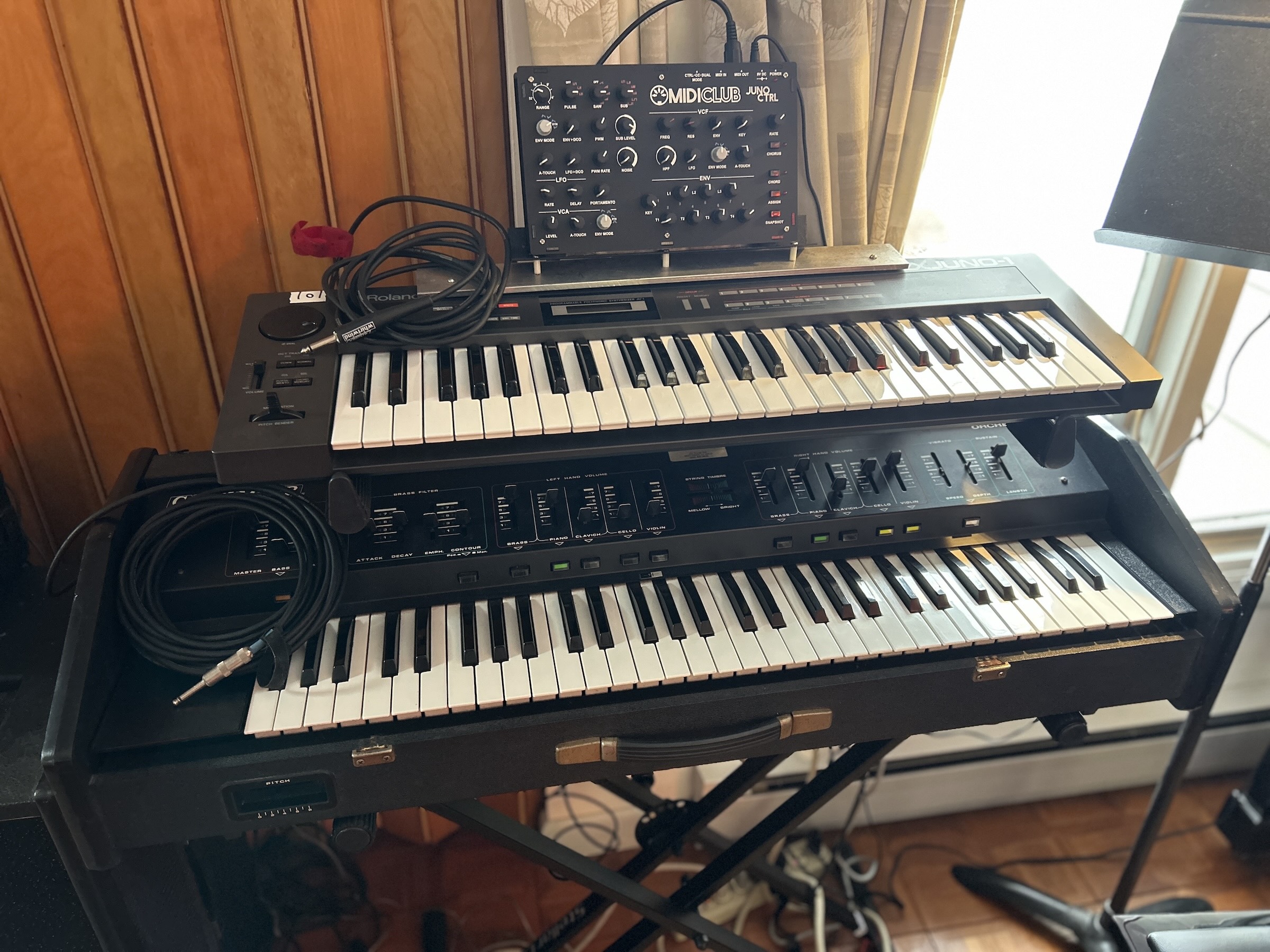
Again, I started with a quarter-note click on Tr4. Next up was my 1980s Roland Alpha Juno on track 1 doing the main part of the song: left-hand octaves defining the harmonic movement and a repetitive three-note right-hand motive. I kinda made up the structure as I went along, trying to add enough variation to ensure that the finished tune would have some dynamics, but not SO MUCH variation that it would be hard to play along to when it came time to do the next 6 passes.
Now that there was a full song-structure laid down, next up was the drumkit on Track 2. After hearing the inadequacies in how the drums translated on the 1st song, I moved the BK5 to a position roughly between the kick and ride (closer to the kick) and aimed at the snare. I also attacked the kick harder this time, as I felt it was not present enough after the bounce in the first song.
Track 3 got bass guitar; I used a Fender Jazz bass for this song, as I wanted more low-end than the Bass VI can provide. I used the same piggyback tube amp, same mic and same inline compressor here.
Time for the bounce. Synth, drums and bass went to track 4 along with a shaker part that i played live into the bounce for all the reasons that i mentioned in my analysis of the prior song. Again, the powerful EQ of the RMX made the bounce much easier to get right. This bounce wipes the click track- although I do make sure to leave a little bit of click present on the tape after the conclusion of the song (for reasons I will explain later).
So now at this point I have the basic keys+drums+bass+perc on track 4, with three tracks now available to record on. It was at this point that I had to bid farewell to the RMX, as the gentleman who had agreed to purchase it arrived at the studio.
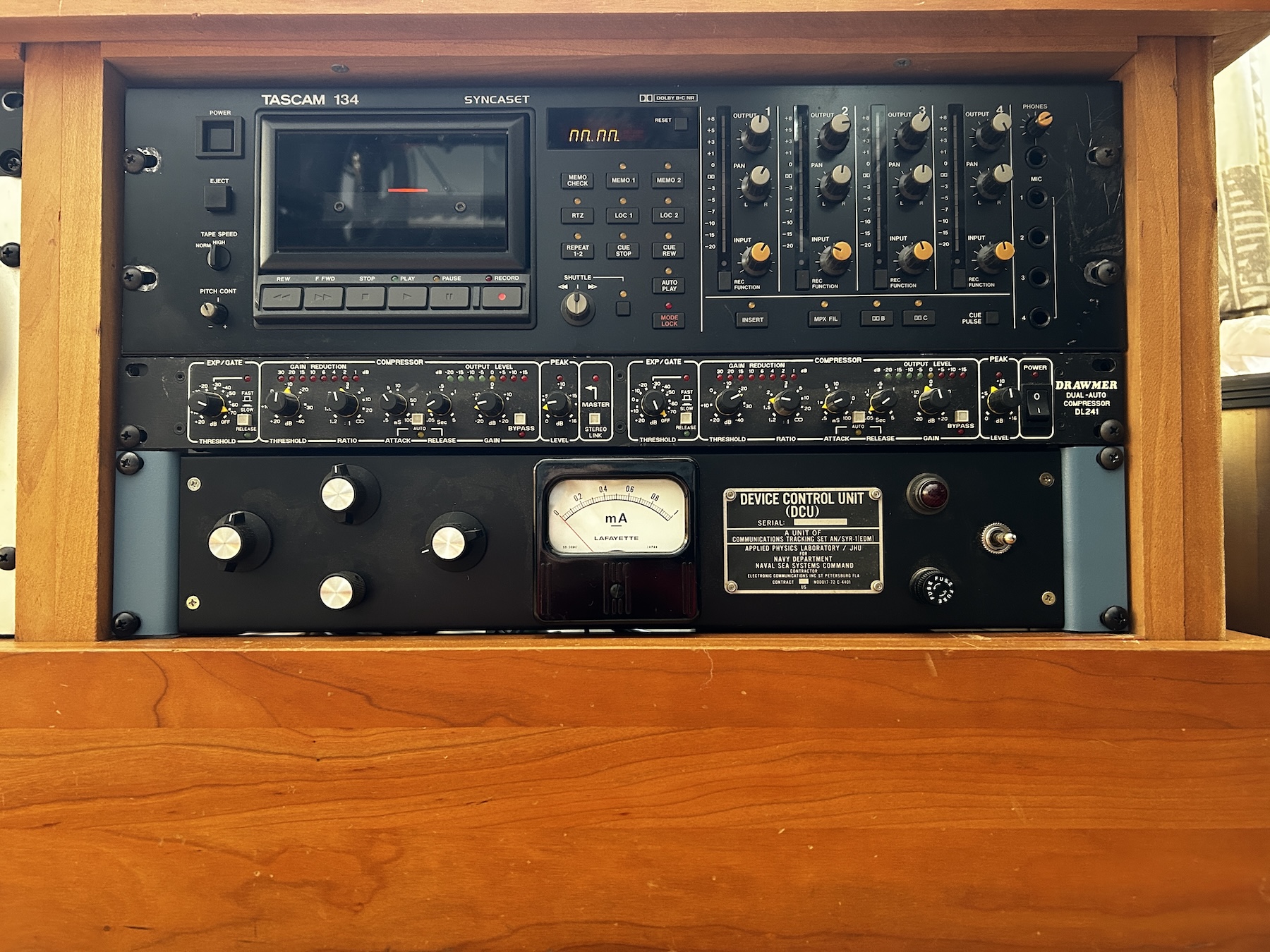
With the RMX gone, I took the tape and stuck it in my Tascam 134 to do the ‘topline’ overdubs and finish the production.
It was at this point that I noticed something interesting. The ‘bounced’ track 4 level was pretty low; low enough that it wasn’t triggering the Dolby C circuit properly. Whether this is an electronic alignment issue or simply some difference in the metering standards of the two machines I cannot say. But regardless: the bounced track 4 sounded basically fine with Dolby ‘OFF’ on the 134 and truly terrible with Dolby ‘ON.’ So I just turned it off and worked without Dolby. The result is that this track is definitely a bit noisier than it would have been if i’d been able to finish it on the RMX; but its fine, hell, let’s call it a feature.
It was also very clear that the RMX and my 134 do not run at the same speed. I very much doubt that these, or any 4-track machine, has true ‘crystal sync’- so this is not surprising. The 134 has a fine pitch-control knob on the panel tho, so it was pretty easy adjust the 134 playback speed to make the recorded material match the A440 standard than it was originally recorded at.
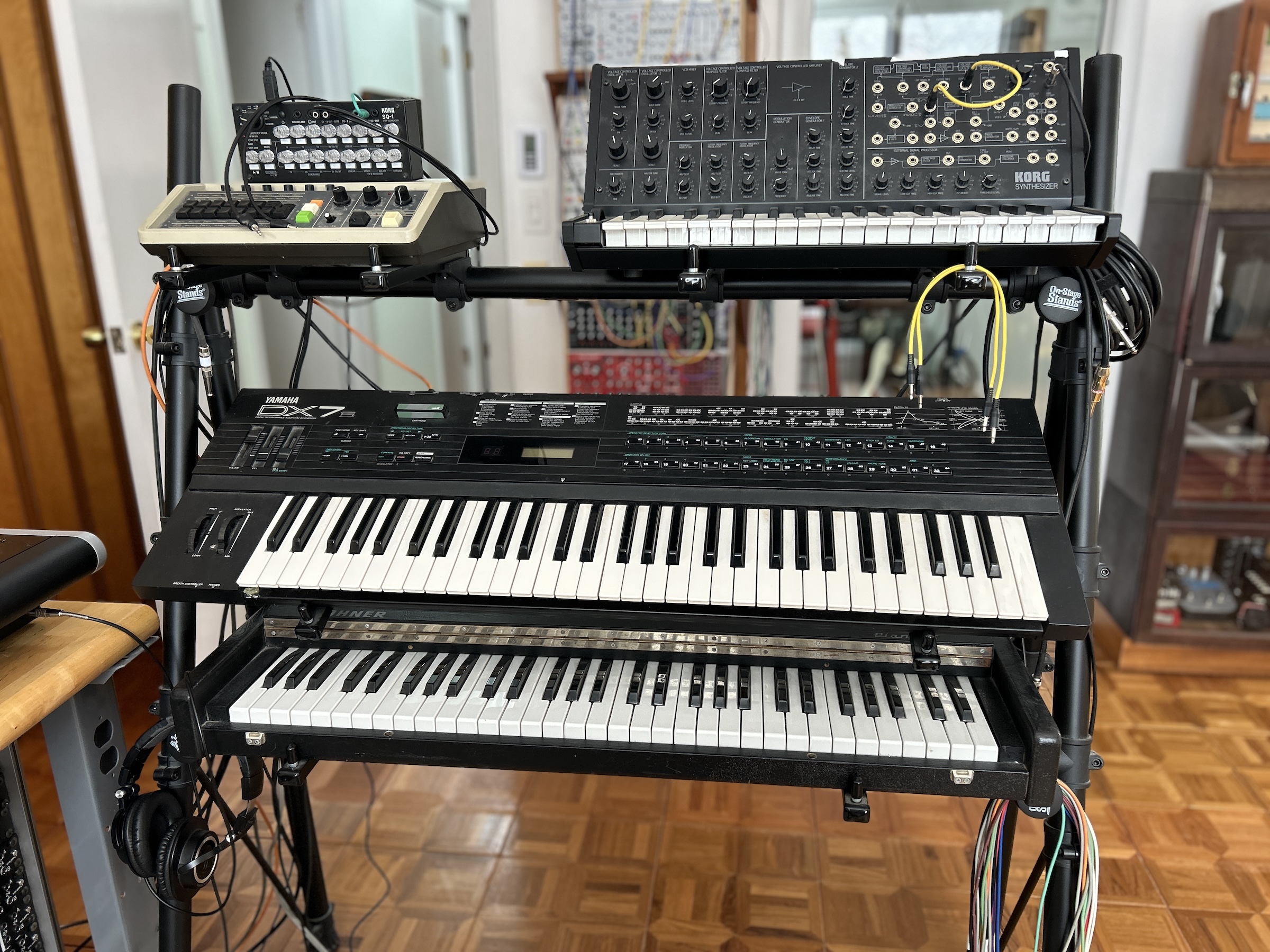
I had initially intended to finish this track using the Roland Alpha the the Crumar Orchestrator in the studio live room (see prev. pix), but the Tascam 134 is rack-bound and I’m way too lazy to move the Crumar. It’s heavy. So i just used the control-room keyboards instead.
Track one got a Pianet part plus a DX7 string part (mixed on the console to one track); track two got a very chorus-y, echo’d-out Les Paul; and the synth lead on track three is that MS20. I used a two-oscillator sound with the Ring Mod setting and you can hear me adjusting the Osc2 pitch knob at the end of each phrase to move the sound in-and-out of harmony.
With all tracking done, I played the four tape tracks into protools and mixed it. Given the genre (is this a genre??) I did some slightly more complex mix moves on this one. For instance, i mult’d the gtr track into 3 different tracks in ProTools for the soft chords, the palm-muted part, and the more aggressive hits, and I mult’d keys track one into separate Pianet and DX7 tracks, so that I could process each of these sounds individually.
I also sidechained the guitar and some of the keys to the kick via a low-pass filter send from track 4 (track 4 is the Juno+bass+drums+shaker bounce). This really helps the kick pop more, especially since it’s already pre-mixed with some many other things.
I will explain now why I leave some of the click present before and after the tune. Having some of the original click, in-sync with the track, helps to easily determine how much drift happened, and also to get the whole production on the grid more easily. I didn’t do any edits on the tracks that you are hearing today, but it is certainly conceivable that I may need to do so in the future if I find a home for either of these tracks or their elements.
Why do I do this sort of thing? Why force myself to perform on instruments (esp. singing!) that I am not proficient in, on outdated equipment that doesn’t allow for fixes, much control, or undo? Well, those are the reasons. Cassette 4-tracking is my form of ‘practice’ as an engineer and producer. It allows for spontaneous discovery; it forces very different outcomes than DAW work or even ‘real’ multitrack work on my 16 track. And it’s a great way to practice the basic art of performance: the mental space that one needs get into in order to execute musically without the possibility of fixing-it-later. These things are fundamental to musical expression as I know it, and yet the new digital tools that we are given constantly seem to be moving us ever further away from them and to… what? Who knows. Better? Worse? Who’s to say.